
Te Puna Raranga — A New Weaving Shelter at Auckland Botanic Gardens
Te Puna Raranga is the new weaving shelter at Auckland Botanic Gardens — a community-designed space within the Pā Harakeke collection where harakeke weaving is practised, taught, and celebrated. The shelter grew out of the weaving community’s long-standing relationship with the collection and their desire for a dedicated place to weave, learn, teach, and connect.
Designed by artist Dr Richard Cooper, Te Puna Raranga features three carved pou by Lorna Rikihana and a shade sail patterned by Te Atiwei Ririnui. Ngāti Tamaoho guided the tikanga for the space and gifted a karakia for visitors to recite before weaving. The shelter carries a name that reflects its purpose — a spring or source of weaving.
Situated alongside one of the region’s largest harakeke collections, the shelter maintains a close connection to the plants that sustain weaving practice. The collection includes weaving cultivars from across Aotearoa, grown and cared for in partnership with local weavers. Harakeke is regularly harvested for raranga and muka preparation, ensuring the plants remain healthy and productive while traditional knowledge continues to flow.
The design of the shelter itself was shaped through collaboration with weavers, who advised on furniture height, accessibility, shade, and layout. The workspace allows easy interaction between teachers and students, including those with access needs, and supports weaving tikanga at every step.
New plantings around the shelter feature species traditionally used for dyeing. Interpretation panels illustrate the colours that can be extracted from plants and lichens, using a colour wheel to help visitors explore the process.
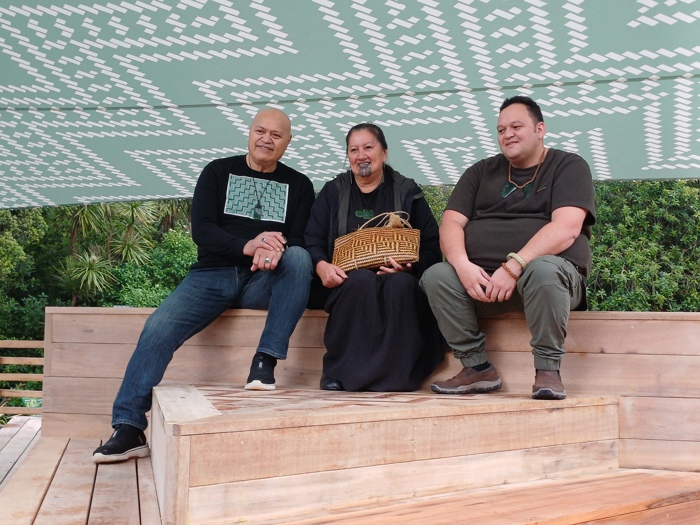
Shelter designer Dr Richard Cooper, carver Lorna Rikihana and pattern designer Te Atiwei Ririnui.
Sustainable surfacing with Porous Lane
The area surrounding Te Puna Raranga also reflects the project’s commitment to environmental sustainability. The pathways and working areas are surfaced with Porous Lane, New Zealand’s only commercially available permeable pavement made from up to 60% recycled tyres.
Selected for its natural appearance and low-impact properties, Porous Lane supports the Gardens’ goals of reducing waste, managing stormwater naturally, and protecting nearby plant roots. As Watersmart Business Development Manager Klaudia Matyjas explains, Porous Lane combines environmental benefits with performance — offering up to 79% less embodied carbon than concrete and up to 45% less than asphalt, while allowing water to filter into the soil beneath.
Installation was undertaken by the Accredited Porous Lane Contractors Siteworks, with City Care Property leading the project. The material aligns with Auckland’s Zero Waste by 2040 and carbon-neutral commitments, and supports the Kia Ora Tāmaki Makaurau framework by honouring the land and deepening the connection between people and place.
An outdoor classroom
Te Puna Raranga now serves as a hub of activity within the Pā Harakeke collection — a place where weaving knowledge grows, where the relationship between people and plant remains active, and where visitors can see the traditions of raranga thriving in a contemporary, thoughtfully designed space.