
Popcorn (Zea mays) trial, summer 2024-5
Samantha van Ryn[1], Ella Rawcliffe, Jodie McDonnell
Introduction
Wild maize (Zea mays) has been cultivated since around 7000BC, when the first crop was found in Mexico. It became a staple crop in North America when it was introduced in 800BC, and is now the most commonly grown crop, used as biofuel, animal feed, and in almost all processed foods, although less than 2% is directly consumed by humans (WRI, 2022). There are more than 500 different by-products of maize. Maize was introduced to Europe as sweet corn and meal and is now the second most important food crop in the world (G.o.C., 2020). Popcorn (select cultivars of Zea mays) can be distinguished from traditional maize, sweetcorn (Zea mays var. saccharata, containing more sugar than starch) and flour corn (Zea mays var. amylacea, with soft endosperm good for grinding) as it contains starch granules which explode upon heating.
Auckland’s subtropical climate makes growing some Zea mays cultivars difficult due to the high potential for pests and diseases to infect plants. Zea mays is often grown outdoors during summer when the climate is humid and hot. The most common problems are aphids, scale, fungal diseases while growing, and weevils once harvested (Lucas, 2005).
Auckland Botanic Gardens (ABG) uses plant trials to test and identify plants that do well in Auckland conditions with desirable characteristics including little or no pests or diseases, long floral displays, productive harvest, uniform habits, and minimal maintenance requirements. This allows ABG to make recommendations of plants suited to the Auckland climate and ensures high performing plants are displayed in the gardens. The aim of this trial was to find top performing popcorn selections that produce a healthy and edible crop that stays pest and disease free, whilst still creating an attractive display.
Methods
Five cultivars of commercially available popcorn from Egmont Seeds, Kōanga Institute and Kings Seeds were selected for the trial, based on their advertised appearance, disease resistance and kernel quality (Table 1). Popcorn seeds were sown in the Botanic Gardens nursery in September 2024, grown on, and planted out in October 2024 in the trials garden at ABG. 25 of each cultivar were planted in blocks. Each cultivar was planted in three rows running north to south and exposed to the prevailing wind. Plants were spaced 20 cm apart. Prior to planting, trial beds were prepared with compost and mulch. Plants were watered during the first two weeks after planting, and snail bait was used once during this time to ensure they had a fair start to life. The only subsequent maintenance was occasional watering, when the soil became particularly dry (no more than once per fortnight).
Table 1 General information and source of five Zea mays cultivars.
|
F1/Heirloom |
Kernel Colour |
Source |
|
|
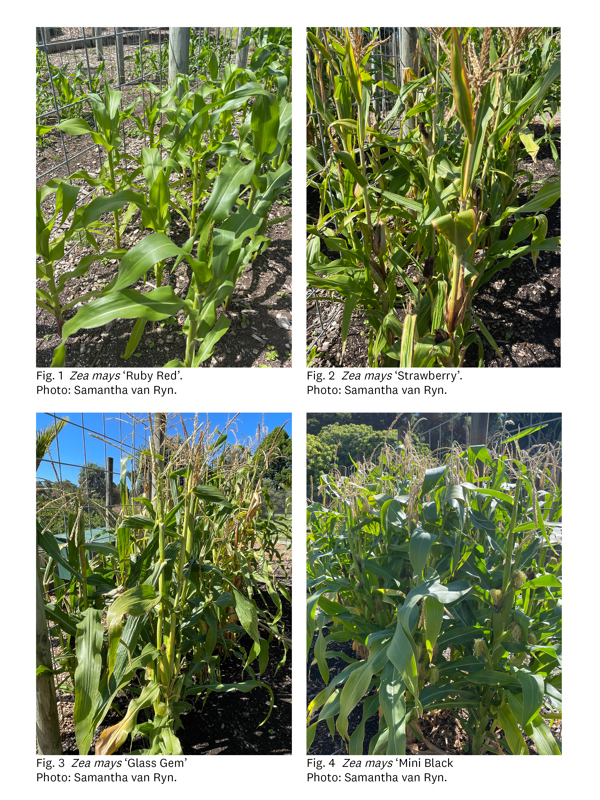
Z. ‘Ruby Red’ (Fig. 1) |
F1 hybrid |
Red |
Egmont Seeds |
|
Z. ‘Strawberry’ (Fig. 2) |
Heirloom |
Red |
Kōanga Institute |
|
Z. ‘Glass Gem’ (Fig. 3) |
Heirloom |
Rainbow |
Kings Seeds |
|
Z. ‘Mini Black’ (Fig. 4) |
Heirloom |
Black |
Kōanga Institute |
|
Z. ‘Mushroom’ (Fig. 5) |
F1 hybrid |
Yellow |
Egmont Seeds |
At maturity, the average height and width (cm) of plants was measured prior to harvest. Pest and disease prevalence was recorded (as percentage affected) upon harvest. An evaluation by a group of staff was conducted in February to assess plants overall and rate them according to ABG star performer criteria (1 = poor performer to 10 = excellent performer). Cultivars that scored 8 or more were considered top performers and are recommended for Auckland conditions based on the results of these trials. The overall rating took into consideration the quality and yield of cobs, absence of pests and diseases, plant habit, and vigour. All cobs were harvested and two of each cultivar were subjected to a qualitative taste test by staff. Cobs were left to dry for two months on the plant, then laid out to dry out for two months in a dry environment.
Results
Upon maturity, the tallest and most vigorous cultivars were Z. ‘Mini Black’, ‘Ruby Red’ and ‘Glass Gem’ (Table 2). All cultivars were afflicted by aphids, with ‘Mushroom’ the worst afflicted. Some cultivars were affected by ‘tassel ear’[1] which is likely to be a result of soil compaction and planting layout. We recommend planting corn as densely as possible, and to plant individual cultivars separate from each other to avoid cross-pollination and potential reduction in cob quality.
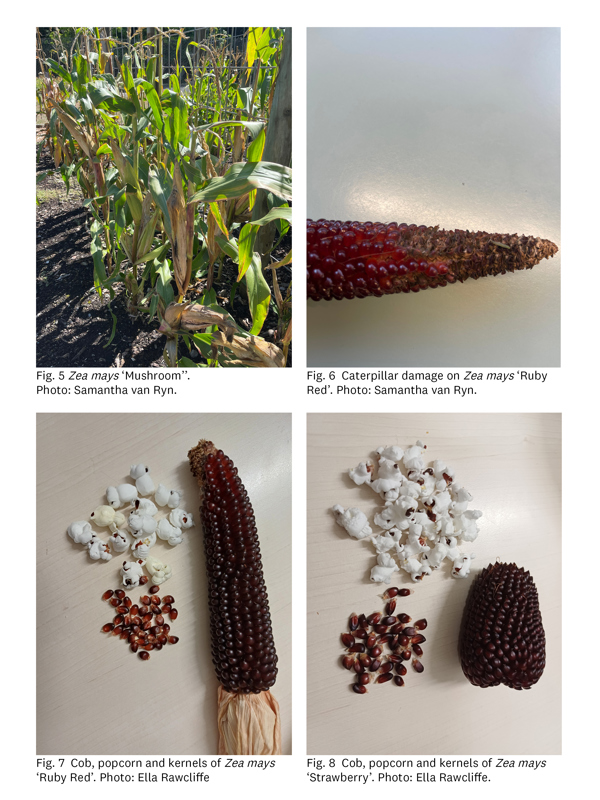
All cultivars had ripened cobs by mid-January 2025 but were left to dry on the plant. Z. ‘Strawberry’ and ‘Mushroom’ were harvested in mid-February, and the three remaining cultivars were harvested at the end of February. All corn was left to dry in trays at room temperature, and after popping, was subject to a taste test in mid-May. Upon harvest, Z. ‘Mini Black’ and ‘Glass Gem’ were the most prolific producers, while ‘Mushroom’ and ‘Ruby Red’ had the largest cobs (Table 3). Z. ‘Mushroom’ and ‘Glass Gem’ had 75% of kernels fertilised, while the remaining three cultivars had all kernels fertilised. While drying inside, it was noted that all cultivars except ‘Mini Black’ were damaged by a mining insect (likely a caterpillar) (Fig. 6).
Table 2 Height and width (cm), pest damage, and overall rating of five Zea mays cultivars. Star performers are indicated with an asterisk (*).
|
Zea mays cultivar |
Habit and average height |
Pests and disease (proportion of plant afflicted) |
Overall rating |
|
Z. ‘Ruby Red’ |
Uniform. 1.51 m |
Aphids <2%, caterpillar on cobs <2% |
8* |
|
Z. ‘Strawberry’ |
Several side shoots. 1.21 m |
Aphids <2%, caterpillar on cobs <2% |
8* |
|
Z. ‘Glass Gem’ |
Few side shoots. 1.87 m |
Aphids <2%, caterpillar on cobs 5% |
9* |
|
Z. ‘Mini Black’ |
Multiple side shoots. 1.66 m |
Aphids <2% |
9* |
|
Z. ‘Mushroom’ |
Uniform. 1.3 m |
Aphids 40%, caterpillar on cobs <2% |
7 |
Table 3 Cob size and yield of five Zea mays cultivars.
|
Zea mays cultivar |
Yield (cobs) |
Average size of cobs (length × width in cm) |
Average weight of cobs (g) |
|
Z. ‘Ruby Red’ (Fig. 1) |
18 |
17.5 × 3 |
72 |
|
Z. ‘Strawberry’ (Fig. 2) |
25 |
8 × 3.8 |
52 |
|
Z. ‘Glass Gem’ (Fig. 3) |
62 |
14 × 2.8 |
52 |
|
Z. ‘Mini Black’ (Fig. 4) |
116 |
11 × 2.5 |
27 |
|
Z. ‘Mushroom’ (Fig. 5) |
15 |
20 × 4.2 |
109 |
Two cobs of each cultivar were popped. All cultivars were good to eat, though were all different in taste and texture. The group evaluation determined that best eating cultivars were Z. ‘Mini Black’ and ‘Glass Gem’, as they had the best texture and were the most uniform. These two, and selections with an overall rating of 8 or higher, are recommended for Auckland conditions.
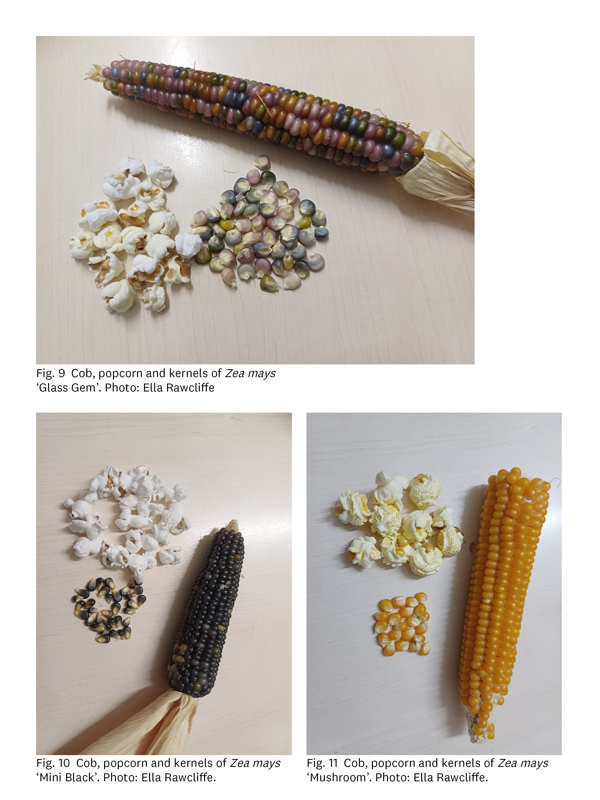
Z. ‘Mushroom’ produced large, round kernels when popped and was uniform in appearance. It had a very different texture to the other corn kernels and is likely more suited to be used as caramel corn. Notably though, it was the only cultivar where all kernels had popped. ‘Strawberry’ produced reasonably small kernels when popped and, due to the small size, not all kernels fully popped. They did have a good ratio of husk to kernel however and were tasty. It may be more successful to pop this cultivar in oil using a frying pan. ‘Ruby Red’ and ‘Glass Gem’ kernels were average compared to the other cultivars, having slightly too much husk to be preferred when eaten. Overall, the favourite popcorn selection was ‘Mini Black’ as there was very little husk left when popped, they had a uniform appearance and texture, and almost all kernels popped (Table 4).
Table 4 Edibility descriptions of five Zea mays cultivars.
|
Zea mays cultivar |
Taste |
|
Z. ‘Ruby Red’ (Fig. 7) |
Average texture, most kernels popped. |
|
Z. ‘Strawberry’ (Fig. 8) |
Very small, but good texture. Only ~60% of kernels popped. |
|
Z. ‘Glass Gem’ (Fig. 9) |
Lots of husk, denser, larger kernel. Most kernels popped. |
|
Z. ‘Mini Black’ (Fig. 10) |
Great texture, very little husk, more than ~95% of kernels popped. |
|
Z. ‘Mushroom’ (Fig. 11) |
Spongy texture, large kernels, all kernels popped. |
Conclusions
From this trial we recommend growing popcorn to any home gardener, as they are a reasonably easy plant to grow and they produce good yields. In particular, we recommend Zea mays ‘Mini Black’ and ‘Glass Gem’, which had the best overall performance in our trial. These two selections had minimal pest and diseases, the largest plants, greatest and most uniform yields and were low maintenance. However, all cultivars grown in this trial performed well under the low maintenance regime and all yielded a reasonable crop. We recommend densely planting corn cultivars and not planting more than one cultivar in an area to prevent issues with cross-pollination. Popcorn is a highly rewarding crop to grow for the average home gardener and has minimal space and management requirements.
References
Bryant, G. ed. (1998). New Zealand Gardening Encyclopaedia. David Bateman Ltd, North Shore City.
Biggs, M. et al. (2013). Vegetables, herbs and fruit: an illustrated encyclopaedia. Firefly, US.
Government of Canada (2020). The biology of Zea mays (L.) (maize). Biology document BIO2020‑01: A companion document to Directive 94‑08 (Dir94‑08), Assessment Criteria for Determining Environmental Safety of Plant with Novel Traits. Retrieved from: https://inspection.canada.ca/en/plant-varieties/plants-novel-traits/applicants/directive-94-08/biology-documents/zea-mays-maize
Lucas, R. (2005). Managing pests and diseases: A handbook for New Zealand gardeners. Craig Potton Publishing, Nelson.
World Resources Institute (2022). The world is growing more crops – but not for food. Retrieved from: www.wri.org/insights/crop-expansion-food-security-trends
[1] Auckland Botanic Gardens, 102 Hill Road, Manurewa 2105, Auckland, New Zealand; samantha.vanryn@aucklandcouncil.govt.nz
[2] ‘Tassel ear’ in corn is a developmental abnormality where kernels grow on the tassel (male flower), instead of – or in addition to – the ear (female flower).
Originally published in the New Garden Garden Journal and should not be reproduced with permission.